
Teeth Whitening Candidacy in Green Bay, WI
Are You a Good Candidate for Teeth Whitening?
Teeth whitening is a popular cosmetic dental service that can brighten your smile and boost confidence, but it’s not the right fit for everyone. Dr. Daniel Fama and Dr. Kyle Whiteside go over the key things they assess for professional whitening in Green Bay, WI—from oral health and sensitivity to the available whitening methods, the consultation process, and aftercare. Knowing these points helps you choose a safe, effective approach that matches your goals.
Ready to find out if you qualify for teeth whitening? Call our dental office in Green Bay at (920) 339-8980 to schedule an appointment. We welcome new and returning patients throughout Green Bay and the neighboring communities of Allouez, De Pere, Bellevue, Howard, and Ashwaubenon.
Who Is a Good Candidate for Teeth Whitening in Green Bay, WI?
The best candidates for professional teeth whitening in Green Bay are adults with healthy teeth and gums whose discoloration comes from extrinsic stains—the surface-level staining caused by coffee, tea, red wine, tobacco, and the natural darkening that comes with age. If your enamel is intact, your gums are disease-free, and you don’t have significant dental restorations in your smile zone, whitening tends to be both safe and effective.
That said, whitening isn’t a universal fix. A short candidacy evaluation at Allouez Family Dental will clarify whether professional bleaching will actually move the needle for you—or whether a different cosmetic approach makes more sense for your specific situation.
Signs You’re Likely a Strong Candidate
- Healthy gums with no signs of active gum disease
- No untreated cavities or exposed root surfaces
- Staining from food, drink, tobacco, or aging (not medication or trauma)
- Mostly natural teeth in the visible smile zone—few dental crowns or dental veneers
- No history of severe tooth sensitivity, or sensitivity that’s manageable
- Realistic expectations about achievable shade improvement
Dental Health Factors That Affect Whitening Eligibility
Your dentist doesn’t just look at the color of your teeth—the entire oral environment matters. Active tooth decay and gum disease take priority over cosmetic treatment. Whitening gel is a peroxide-based agent, and applying it over compromised tissue or an open cavity can intensify sensitivity and cause unnecessary discomfort. Those conditions are addressed first, then whitening proceeds on a healthy foundation.
Restorations are the other key variable. Composite fillings, porcelain crowns, and dental veneers don’t respond to bleaching agents—they were fabricated to match a specific shade, and that shade stays fixed. If you have prominent restorations in your front teeth, your dentist will discuss this honestly upfront: Whitening may create a shade mismatch if you lighten the surrounding natural teeth beyond the restoration’s color. In some cases, replacing or updating the restoration after whitening is part of the plan.
Does Tooth Sensitivity Rule You Out?
Not necessarily—but it changes the approach. Sensitivity during or after whitening is the most commonly reported side effect, and it’s typically temporary. For patients with a history of sensitivity, dentists can:
- Use desensitizing agents (potassium nitrate or fluoride) applied before and after treatment to calm the nerve response
- Extend the treatment schedule—slower, lower-concentration at-home kits often produce less acute sensitivity than single-session in-office whitening
- Recommend pre-treatment with sensitivity toothpaste for two weeks before bleaching begins
- Shorten wear time per session to allow the nerve to recover between applications
Severe, chronic, or unexplained sensitivity is investigated before any whitening begins—it may signal an underlying issue like a cracked tooth or exposed dentin that needs attention first.
When Whitening Should Wait—Disqualifying Conditions
Some situations call for a pause or redirect rather than treatment. Your provider will flag these during the evaluation:
Conditions That Delay or Redirect Whitening
- Active cavities or untreated decay must be restored first
- Active periodontal (gum) disease requires treatment and stabilization
- For intrinsic staining from tetracycline antibiotics or fluorosis, bleaching has a limited effect; veneers may be a better option
- Tooth discoloration caused by trauma or a non-vital (dead) tooth—internal bleaching or a crown may be more appropriate
- Pregnancy or nursing—a precautionary pause until after the pregnancy
- Extensive restorations in the smile zone—the outcome may be uneven without a restoration update plan
Being told to wait isn’t a dead end. In most cases, there’s a clear path—restore the decay, treat the gum issue, then schedule whitening. Your provider will outline the sequence.
What Happens During a Candidacy Evaluation at Allouez Family Dental?
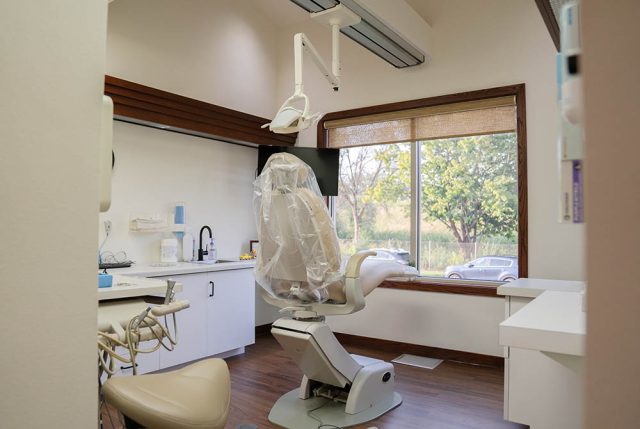
A whitening candidacy assessment is typically built into a standard dental consultation. Here’s what to expect at our Green Bay office:
- Health history review—your provider asks about sensitivity history, current medications, and any prior whitening experience
- Visual oral exam—teeth and gums are examined for decay, recession, existing restorations, and gum health
- Shade assessment—your current shade is documented; your provider will give a realistic estimate of how many shades improvement is achievable with your enamel type and stain depth
- X-rays, if needed, to rule out issues not visible on the surface
- Treatment recommendation—in-office whitening, a custom take-home kit, or a different cosmetic option if whitening isn’t the right fit
The consultation is the part where you get real information rather than assumptions. Shade outcomes vary significantly by person—your dentist can give you an honest projection based on your specific enamel and stain type.
In-Office vs. Take-Home Whitening: Which Fits Your Candidacy Profile?
Both options are professionally supervised—the difference is concentration, speed, and control. Your candidacy profile often influences what is recommended.
In-Office Whitening
- Higher-concentration gel applied by your clinician in a single visit
- Visible results in approximately one hour
- Gum tissue is protected by your provider throughout the procedure
- Best for patients who want fast results or are preparing for an event
- Less ideal for patients with significant sensitivity due to the higher gel concentration
Top-up appointments scheduled as needed to maintain shade
Take-Home Whitening Kits
- Custom-fitted trays with a lower-concentration professional gel
- Gradual brightening over several days to a few weeks
- Custom trays limit gel contact with gum tissue
- Better option for patients with a history of sensitivity—slower and more controlled
- Flexible schedule you manage at home, at your own pace
- Easy to continue maintenance long-term with the same trays
Patients with moderate sensitivity often do better with take-home kits. Patients who want fast results for an event or who prefer a supervised single session often choose in-office. Many patients use a combination—in-office for the initial result and take-home trays for long-term maintenance.
Realistic Expectations: What Whitening Can and Can’t Fix
Professional whitening works best on yellow-toned extrinsic staining. It’s less effective on gray-toned discoloration (often linked to tetracycline) and has no effect on intrinsic staining caused by fluorosis, internal trauma, or non-vital teeth.
Most patients with eligible staining see improvement of two to eight shades, depending on their enamel porosity, the depth of staining, and their starting shade. Results from in-office treatments typically hold for six months to two years with good oral hygiene and dietary habits. Tobacco use and regular consumption of staining beverages will accelerate fading.
The single most important expectation to set before whitening: restorations don’t bleach. Your natural enamel will lighten; your crowns, veneers, and composite fillings will not. If those restorations are in a visible area, your dentist will address this in the treatment plan.
Post-Whitening Care to Protect Your Results
Candidacy isn’t just about whether whitening will work—it also means being ready to maintain results. After treatment, the enamel is temporarily more porous and more susceptible to staining. During the first 48–72 hours, avoid:
- Coffee, tea, and red wine
- Dark berries, tomato-based sauces, and soy sauce
- Tobacco products in any form
- Colored mouthwashes
Beyond the immediate window, daily brushing and flossing, staying hydrated, and attending regular cleanings are the highest-impact habits for preserving your shade. Periodic touch-ups, typically every 6 to 18 months, depending on your habits, keep results consistent over time. Your dentist will advise on the right interval for your lifestyle.
Frequently Asked Questions
Most dentists recommend waiting until at least age 16, when adult teeth are fully erupted and pulp chambers have matured enough to reduce sensitivity risk. For adolescents, a dentist will evaluate dental maturity and overall oral health individually before recommending any whitening treatment.
No—bleaching agents don’t affect porcelain, ceramic, or composite resin. Crowns, veneers, and tooth-colored fillings hold their fabricated shade. If these restorations are in prominent positions, your dentist will discuss whether a shade mismatch could result and how to plan around it.
Extrinsic staining (surface-level, good whitening candidate) tends to be uniform yellowing or brownish tones linked to diet, tobacco, or aging. Intrinsic staining (within the tooth structure) often appears grayish or banded and is associated with tetracycline use during tooth development, fluorosis, or trauma. Your dentist can confirm the type during a visual exam and advise accordingly.
A prior bad experience doesn’t automatically disqualify you. Mention it at your consultation and describe what product you used and how it felt. There are desensitizing protocols, lower-concentration gel options, and modified schedules that can make the process manageable for sensitive patients. Your provider will design around your history.
A professional cleaning before whitening is strongly recommended and is often part of the pre-treatment plan. Tartar and plaque deposits can block the gel from reaching the enamel evenly, and removing them first gives you a more uniform result. If you’re overdue for a cleaning, scheduling one before your whitening appointment is a smart first step.
Ready to Find Out If You Qualify for Whitening?
Understanding who qualifies for professional teeth whitening is essential for achieving a safe and effective enhancement to your smile. A brief consultation with a qualified dentist will assess your oral health, present suitable treatment options, and establish realistic expectations for your results. If you’re interested in exploring teeth whitening in Green Bay, we invite you to schedule a consultation tailored to your individual needs.
Contact our dental practice in Green Bay at (920) 339-8980 to arrange an appointment. We proudly serve patients from Green Bay, Allouez, De Pere, Bellevue, Howard, and Ashwaubenon.